


A bed that suddenly starts squeaking can be difficult to ignore. Perhaps it only happens when you turn over, or maybe you’ve reached the point where the slightest movement produces a creak from the frame.
Before blaming the mattress – or deciding the bed has had its day – it’s worth doing a few simple checks. Loose fittings and moving slats are common causes of squeaking in wooden beds, and sometimes the noise is simply coming from two parts of the frame rubbing against each other.
Finding the source is usually the trickiest part. Once you know what’s making the noise, the fix itself may be surprisingly simple.
Why Does My Bed Squeak?
Most squeaks come down to one of two things: something is moving when it shouldn’t be, or two surfaces are rubbing together.
A bolt may have loosened after years of use. A wooden slat might be shifting every time you turn over. The headboard could even be tapping against the wall without you realising it.
Common causes include:
- Loose bolts, screws or joints
- Slats that have moved out of position
- Wood rubbing against wood
- A loose headboard
- An uneven floor
- Movement in the centre support
- A damaged or warped slat
- The mattress itself
Timber moves naturally too. Changes in temperature and humidity can cause wood to expand and contract slightly, which may explain why a previously quiet bed suddenly develops the odd creak.
Before reaching for the toolbox, though, find out where the sound is actually coming from.
How to Find Where Your Bed Is Squeaking?
Don’t assume the squeak starts where you hear it. Sound travels surprisingly well through a wooden frame, so a noise that seems to come from the headboard could actually begin at a joint or slat.
Take the mattress off and put it on the floor. Press down in different places and move around on it. Still squeaking? There’s a good chance the mattress is responsible.
No noise? Now investigate the frame.
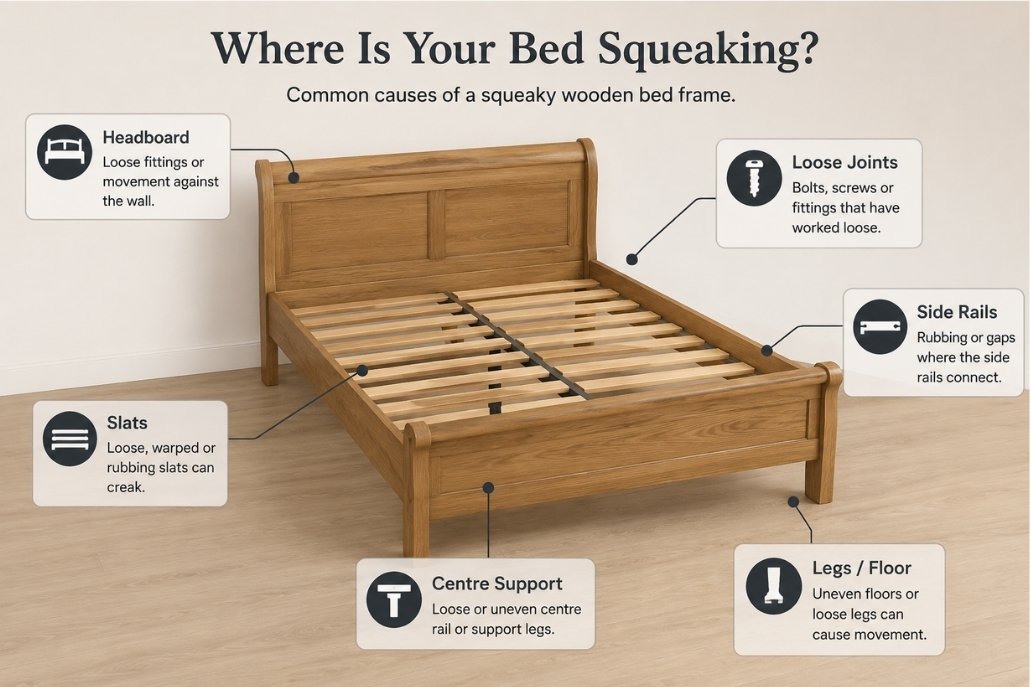
Gently rock the empty bed from side to side and press each corner. Try the headboard and footboard, then work your way across the slats one at a time.
Finally, look underneath. Check the centre rail and support legs and see whether all the bed’s feet are sitting firmly on the floor.
You should now have a much better idea of where to concentrate your efforts.
How to Stop a Wooden Bed From Squeaking?
Once you’ve found where the noise is coming from, in many cases, you won’t need much more than a few basic tools and a little patience to sort it out.
Here are eight fixes worth trying.
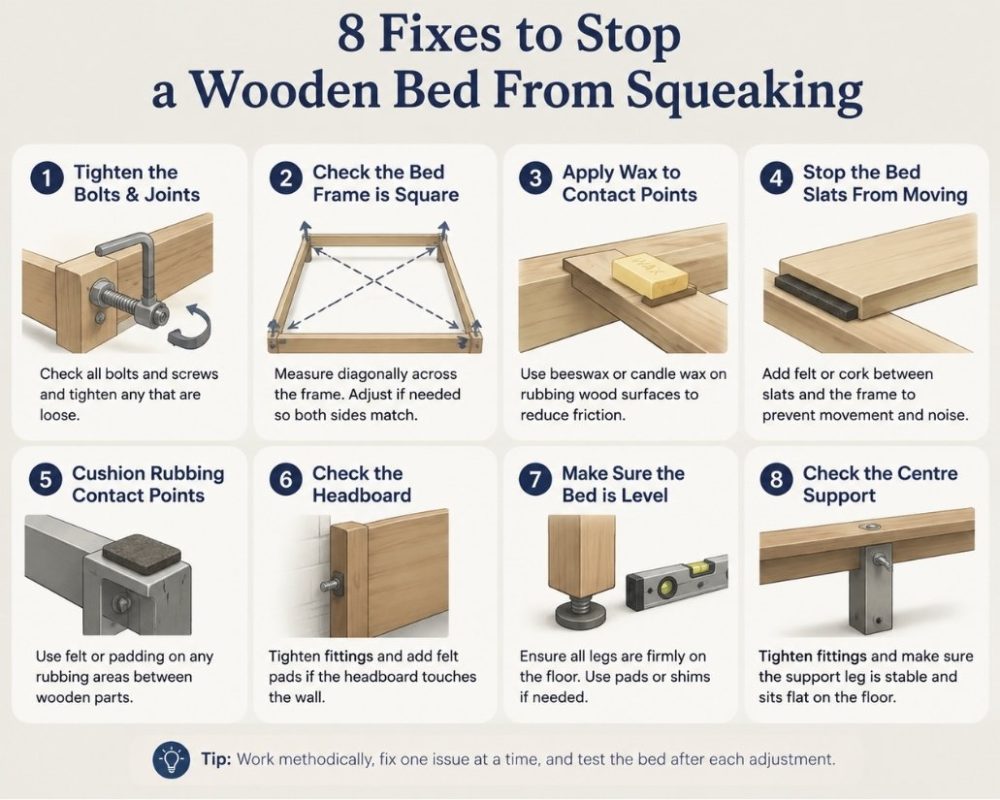
1. Tighten the Bolts, Screws and Joints
Start with the obvious one. Bed frames put up with movement night after night, so it’s hardly surprising that a fitting can eventually work itself loose.
With the mattress removed, go around the whole frame and inspect the fittings, particularly where the side rails meet the headboard and footboard.
Use the correct Allen key, screwdriver or spanner to tighten anything that has some play in it. Firm is what you’re aiming for; overtightening can damage the hardware or timber.
Give the frame another gentle rock when you’re done. You may find that’s all it needed.
2. Check That the Bed Frame Is Square
Bolts all tight but the bed still creaking? Take a look at the frame itself.
If a bed is slightly out of square, its joints can sit under uneven pressure and shift when you climb in or turn over.
Measure diagonally across the empty frame from one corner to the opposite corner, then measure the other diagonal. The two measurements should be roughly the same.
If there’s a noticeable difference, loosen the relevant fittings slightly, straighten the frame and measure again. Once it’s square, tighten everything back up.
3. Apply Wax to Wooden Contact Points
Everything looks tight, nothing appears broken, yet the bed still complains whenever you move? Two pieces of wood may simply be rubbing together.
Once you’ve pinpointed the troublesome area, look for movement where the wooden surfaces meet. A light coating of beeswax, paraffin/candle wax or suitable furniture wax on the rubbing surfaces can help reduce the friction.
4. Stop the Bed Slats From Moving
If you’ve tightened the frame and the mystery squeak is still there, the slats are one of the next places to look.
Press each slat individually. Does one move more than the others? Can you hear it rubbing against the side rail? Look for cracks and badly warped slats while you’re there.
If a sound slat is rubbing against its support, a thin strip of felt or cork between the contact surfaces can help. Keep it thin so the slat still sits correctly.
There’s no need to start gluing or screwing every slat down. Some slat systems are designed to have a little movement. A cracked or badly warped slat, however, is better replaced than padded.
5. Cushion Rubbing Contact Points
Slats aren’t the only places where a little cushioning can help.
Listen while moving the frame and look for hard surfaces rubbing together. A small piece of felt, cork or suitable furniture padding at the problem spot may be enough to silence it.
This can be particularly useful around brackets and fittings or between wooden components that have developed a small amount of movement over time.
Keep the padding thin so it doesn’t interfere with the way the bed fits together.
6. Check the Headboard
A noisy headboard can be surprisingly convincing. What sounds like a creak deep inside the frame may simply be the headboard moving whenever you turn over.
Give it a gentle push. If there’s movement, check and tighten its fittings.
Still hearing something? Look behind it. The headboard could simply be touching the wall. Moving the bed forward slightly or adding small felt pads at the contact points may solve the problem.
7. Make Sure the Bed Is Level
Here’s another culprit that’s easy to overlook: the floor.
If one foot sits slightly higher or lower than the others, the bed can rock as your weight shifts across it. That movement travels through the frame and may cause the joints to creak.
Gently rock the bed and watch the feet. They should all sit firmly on the floor.
If you find a small gap, a suitable furniture pad or shim can help level the frame. Rugs can cause the same problem, particularly if only some of the bed’s feet are sitting on them.
8. Check the Centre Support
Larger beds often have a centre rail and one or more support legs underneath. These can squeak too.
Try moving the centre rail gently and check its fittings. The support legs should also be stable and sit correctly on the floor.
A loose centre support can shift whenever your weight moves across the mattress. If you discover a broken structural support, use the correct replacement part rather than improvising a repair.
What If the Mattress Is Squeaking, Not the Bed?
If your earlier test pointed to the mattress, tightening the bed frame isn’t going to make much difference.
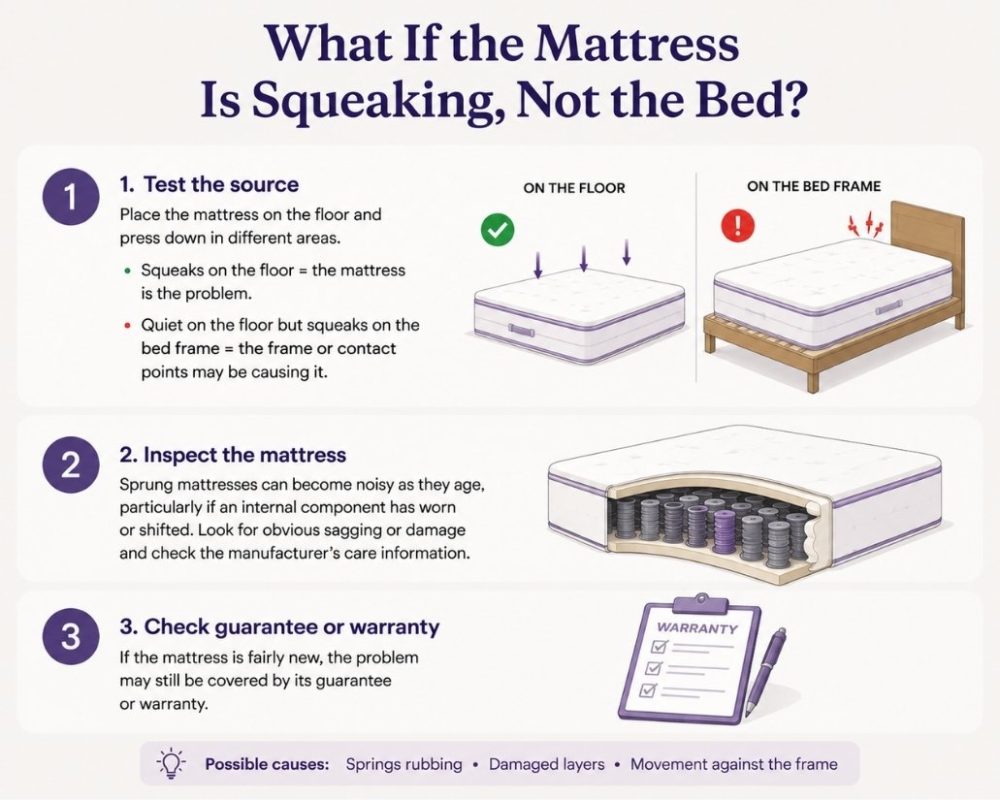
Sprung mattresses can sometimes become noisy as they age, particularly if an internal component has worn or shifted. Look for obvious sagging or damage and check the manufacturer’s care information.
If the mattress is fairly new, the problem may still be covered by its guarantee or warranty.
Still unsure? Put it back on the bed. If it’s quiet on the floor but starts squeaking on the frame, return to the slats and contact points – the interaction between the mattress and frame may be causing the noise.
When Should You Replace a Squeaky Bed Frame?
A squeak by itself isn’t a reason to give up on your bed. If you’ve tracked the noise down to a loose bolt, a rubbing slat or another small fitting, chances are it can be sorted without much trouble.
It’s a different story when the frame itself has seen better days. Have a good look at the timber and the main joints. Cracks, badly warped wood or broken slat supports deserve more attention than the occasional creak. The same applies to a joint that keeps coming loose no matter how many times you tighten it.
One useful test is simply to give the bed a gentle shake. Does it still feel solid? If it wobbles noticeably after you’ve tightened the fittings and checked that it’s level, there may be more going on than a noisy joint.
At that point, don’t keep chasing the squeak with temporary fixes. If you’re not sure whether the damaged part can be repaired, ask the manufacturer or an experienced furniture repairer to take a look.
How to Choose a Wooden Bed That’s Less Likely to Squeak
No wooden bed can be guaranteed never to make a sound. After years of nightly use, even a well-made frame may occasionally need a fitting tightened.
Good construction still makes a difference.
When choosing a wooden bed frame, look for sturdy joints, good-quality fittings and properly supported slats. Larger beds should also have an appropriate centre support system.
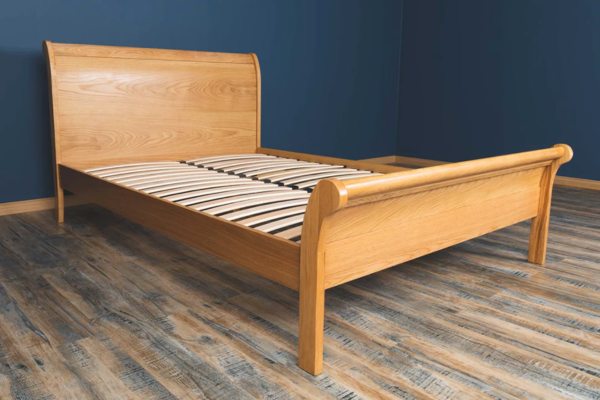
The Mayfair Solid Natural Oak Sleigh Bed Frame is one example of a sturdy wooden design, made from American white oak and real oak veneer and supplied with posture-sprung wooden slats. Its solid construction and supportive slat system are useful features to look for when choosing a new wooden bed.
Correct assembly matters too. Take the time to build the frame properly, keep it square and make sure the fittings are secure.
It’s also worth checking them every now and then. Catching one loose bolt early is considerably easier than hunting for a mysterious squeak at two in the morning.
Frequently Asked Questions
Do Wooden Beds Naturally Squeak?
Not necessarily. A well-assembled wooden bed should be quiet, although timber naturally responds to changes in temperature and humidity. Everyday use can also loosen fittings over time. If a previously quiet bed starts creaking, investigate the joints and slats first.
Can You Use WD-40 on a Squeaky Wooden Bed?
It depends on what’s squeaking. For two wooden surfaces rubbing together, beeswax, candle wax or suitable furniture wax is generally the better option. WD-40 and similar lubricants are better kept for appropriate metal components rather than wooden contact points.
Why Does My Bed Squeak When I Move?
Because your movement is making something else move too. It could be a loose joint, a slat shifting against its support, the headboard moving or even a centre leg rocking on the floor. Try reproducing the sound with the mattress removed to narrow down the cause.
Can Bed Slats Cause Squeaking?
Absolutely. A wooden slat can creak as it moves against the side rail or centre support, even when there’s nothing wrong with the slat itself. Press them one at a time to find the noisy one. If it’s undamaged but rubbing, a thin piece of felt or cork at the contact point may help.
Final Thoughts
A squeaking bed can sound like a much bigger problem than it really is. Quite often, the fix turns out to be a loose bolt, a wandering slat or one small area where two parts of the frame are rubbing together.
Start with the simple checks and work your way through the bed rather than trying everything at once. Find the source, fix that particular problem and test the frame again.
With a bit of luck, the next time you turn over in the middle of the night, you won’t hear a thing.